












Electrochemical Marking and Etching Machine EUmark SUPER SET 04
Original price was: 999.99 €.799.99 €Current price is: 799.99 €.
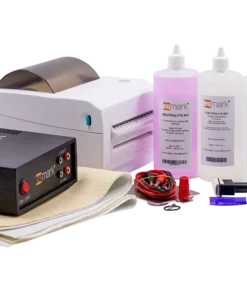
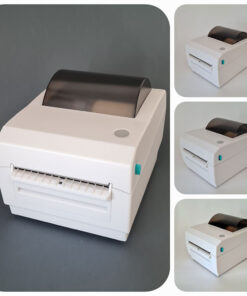
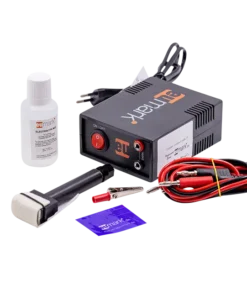
The complete marking system: machine, stencil printer and a full set
of consumables. SUPER SET 04 removes the one thing that slows down
serialised marking — waiting for stencils. Print the stencil on the bench,
mark the part, move on. Both black oxide marking and deep etch are available
from the same unit.
- Stencil printer 410, 108 mm wide, with a 100 m roll of stencil tape included
- Around 10 seconds per part from mark to loading the next one — roughly 6 parts a minute
- Variable data — serial numbers, lot codes, dates, UDI carriers — without ordering a new stencil each time
- Full 200 ml bottles of M21, M22, M23 and N11 Neutralyte — one bottle covers up to 20,000 marks
- Electrolytes formulated for medical, aerospace and food-contact production, with safety data sheets supplied for your quality file
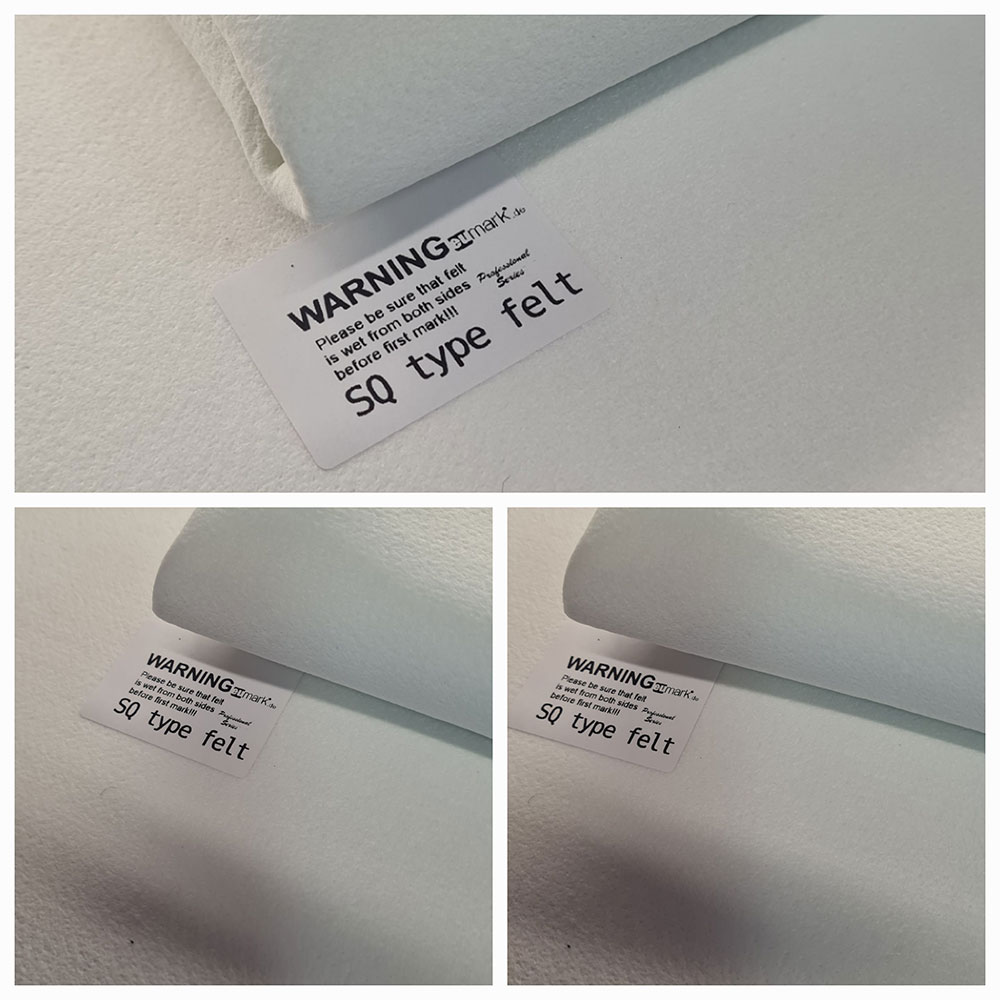
- Two 375 × 500 mm marking felt sheets, enough for extended production
- No heat-affected zone, no residual stress, no dimensional change to the part
- Ships under SAA preferential origin with EUR.1 or invoice declaration
EUmark SUPER SET 04 — marking system with in-house stencil production
Most workshops that adopt electrochemical marking hit the same wall within a
few months. The marking itself takes two to five seconds. Getting a stencil for a part
number that has never been marked before takes days. As soon as identification
requirements move from a fixed company logo to per-part data — serial numbers,
batch codes, manufacturing dates, unique device identifiers — the stencil supply
chain becomes the constraint, not the process.
SUPER SET 04 closes that gap. The stencil printer sits next to the marking
unit; a new stencil is produced in a couple of minutes from whatever text the
job traveller calls for. The lead time on a one-off part number drops from days
to the time it takes to type it.
What this system is bought for
- Serialised production — every part carrying a different number, marked at the point of final inspection
- Medical device identification — UDI carriers and instrument identification under EU MDR 2017/745, applied to reusable instruments that must survive their full reprocessing life
- Aerospace subcontract work — part, serial and lot identification to customer drawing notes, on components where surface integrity is controlled
- Short-run and prototype work — first articles and small batches where ordering a photo stencil per design cannot be justified
- Multi-customer contract manufacture — different marking content for different customers, from one bench
Two marking modes from one unit
| Mode | Result | Typical use |
|---|---|---|
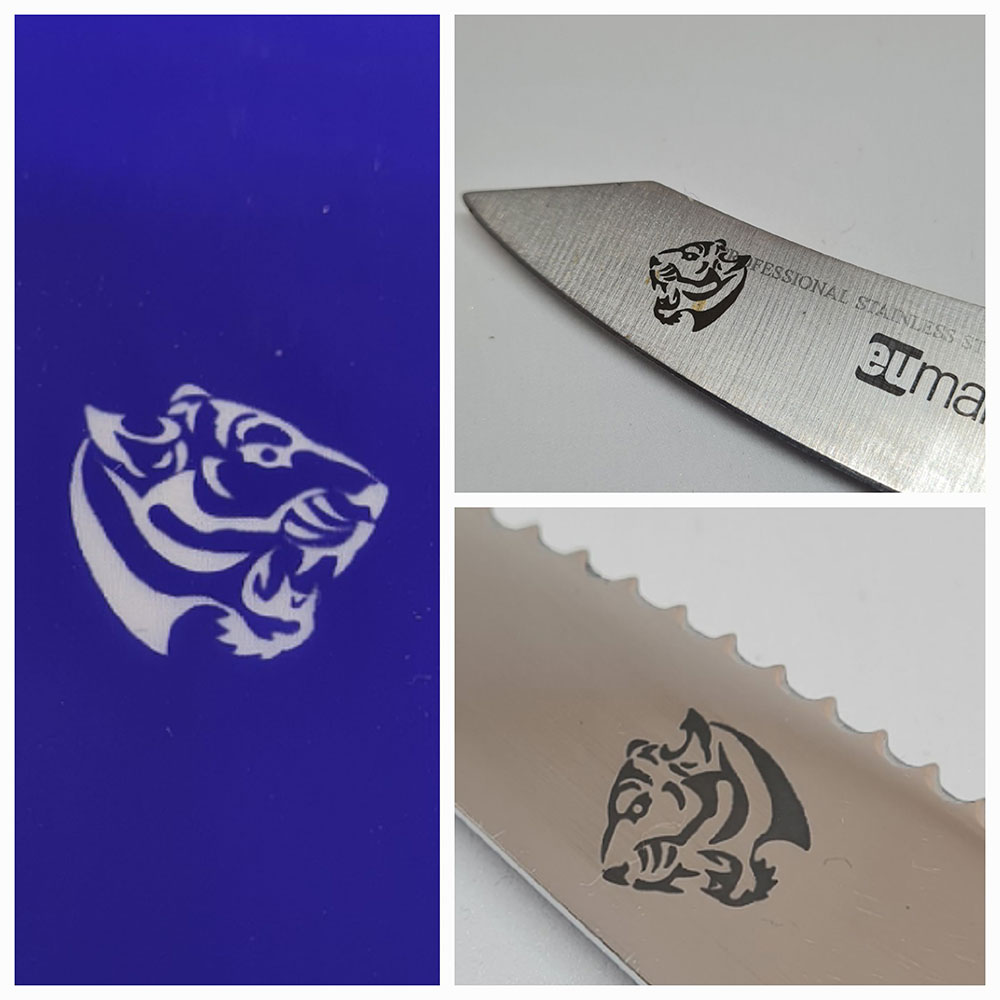
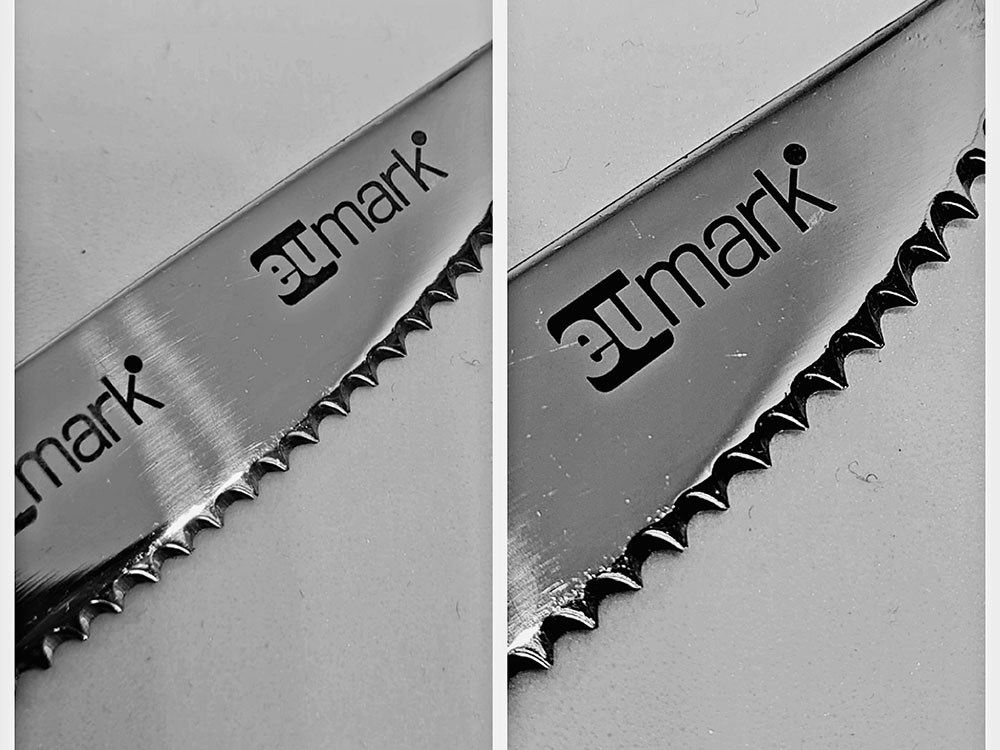
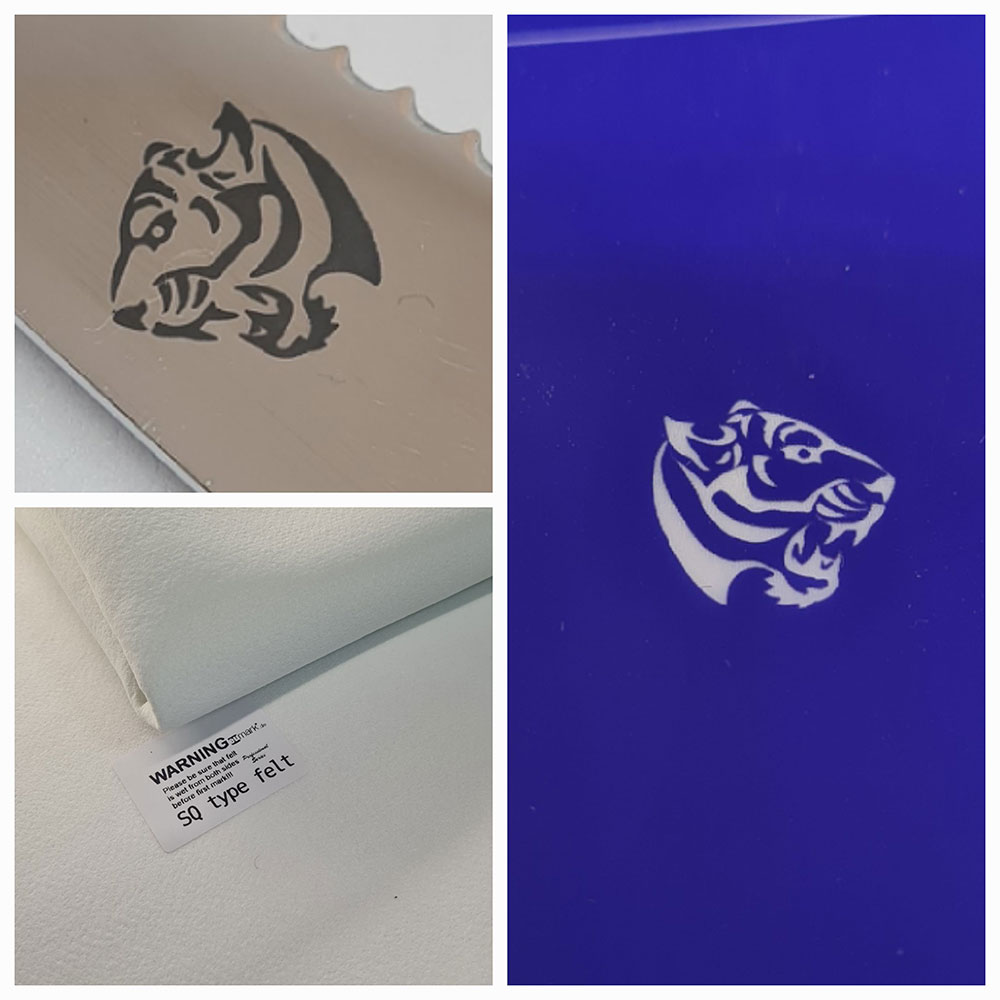
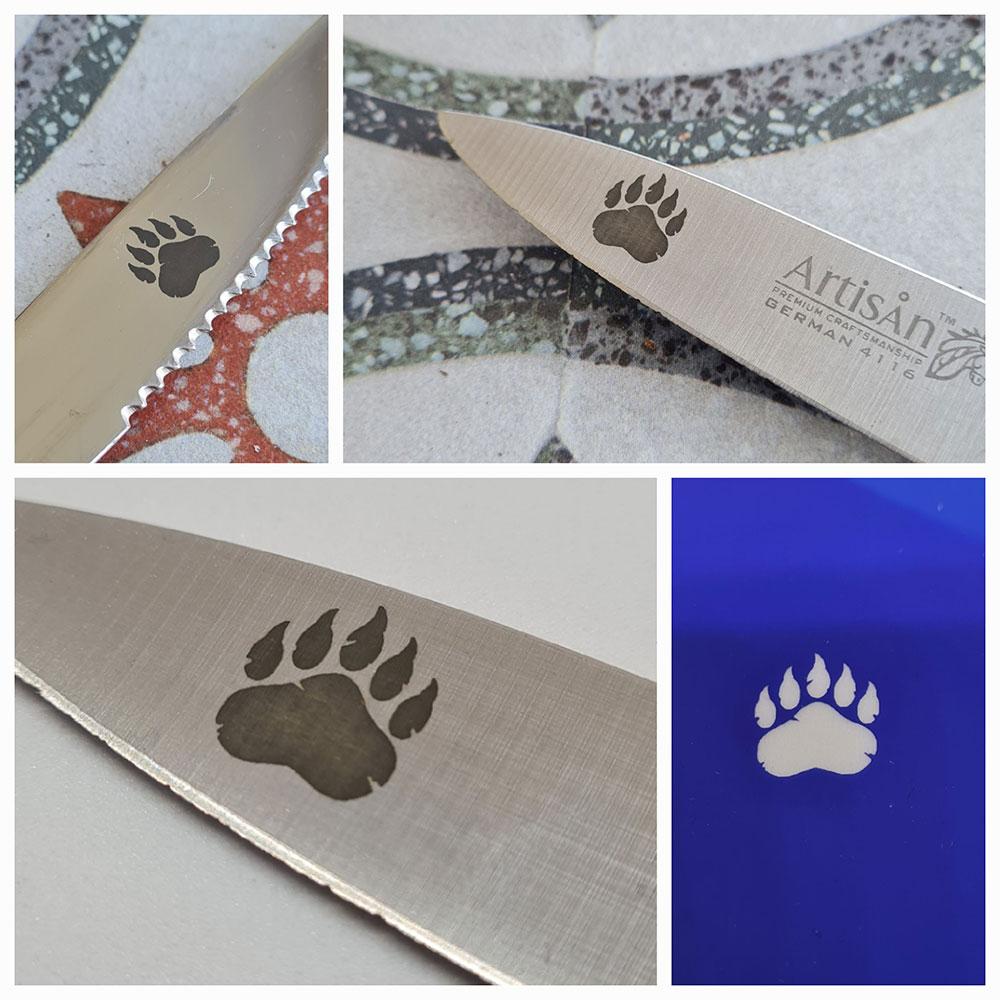
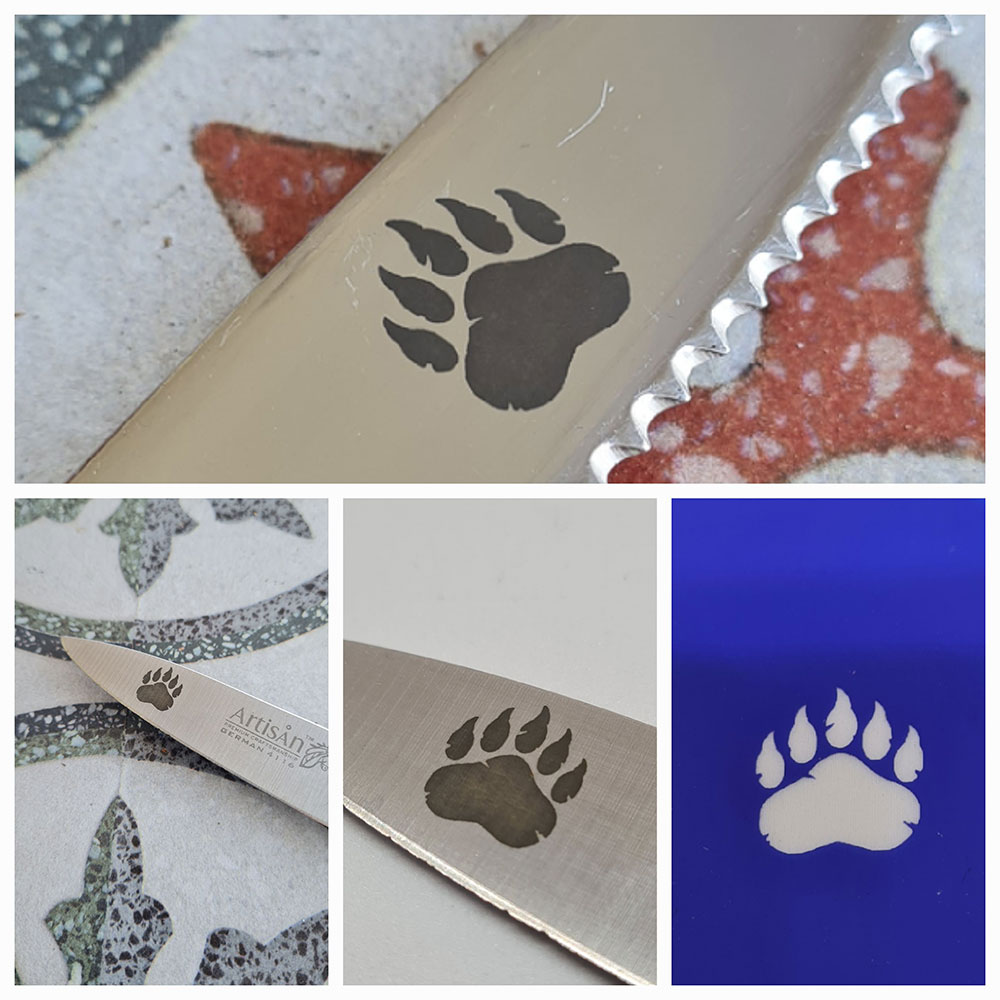
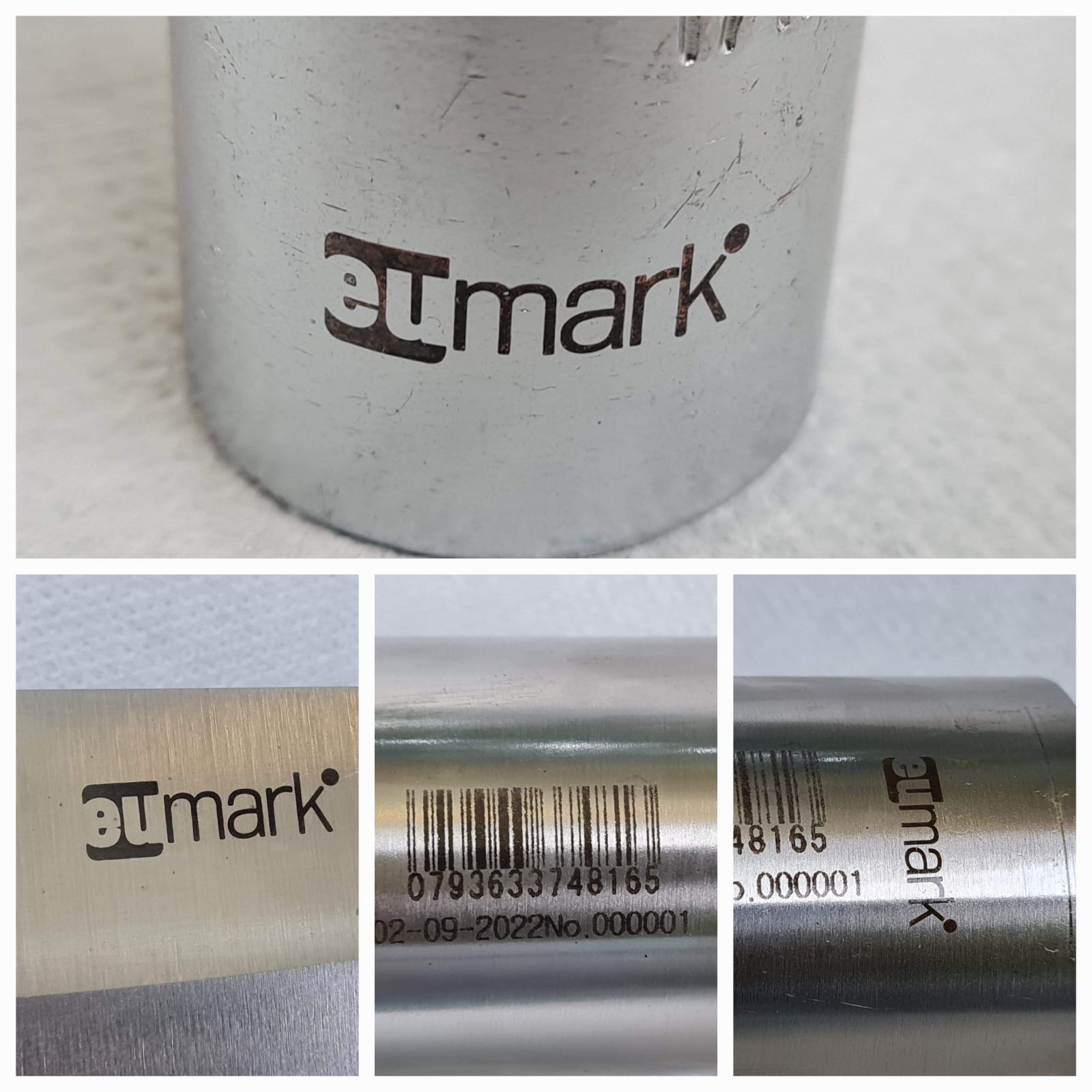
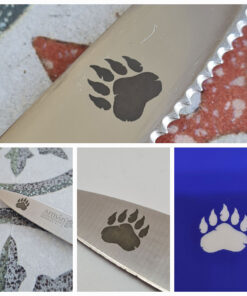
| Black oxide marking | High-contrast dark mark, shallow surface conversion | Identification on polished and satin stainless where legibility matters more than depth |
| Deep etch, light marking | Recessed mark with a lighter tone, greater depth | Marks that must remain legible after further finishing, handling or service wear |
Both modes are available in SUPER SET 04. The compact sets — 05 and 06 —
provide black marking only. If your customer specification calls for a stated
etch depth rather than contrast alone, this is the set that covers it.
Scope of delivery
| Marking unit | 1 pc, 110 V / 220 V, with supply and marking leads |
|---|---|
| Stencil printer | Model 410, 108 mm / 4″ print width |
| Stencil tape | 1 roll, 108 mm × 100 m |
| Stencil design software | Included — serial numbers, QR, barcode, image import; no separate licence purchase |
| Hand stamp | 1 pc, manual marking head |
| Marking felt | 2 sheets, 375 × 500 mm (10″ × 19″) |
| Electrolyte M21 | 200 ml |
| Electrolyte M22 | 200 ml |
| Electrolyte M23 | 200 ml |
| N11 Neutralyte | 200 ml |
| Long-life stencil | 1 sample |
| Quick stencil | 1 sample, produced on the supplied printer |
SUPER SET 04A is the same configuration with 50 ml electrolyte bottles
instead of 200 ml. Choose 04A for evaluation and low volume, 04 for production.
Technical data
| Process | Electrochemical (electrolytic) marking, AC and DC modes |
|---|---|
| Supply | 110 V / 220 V AC — supplied ready for EU, UK and US mains, no modification required |
| Output voltage | 10–15 V |
| Maximum output current | 15 A |
| Power consumption | up to 150 W at peak |
| Protection | Fuse and thermal fuse |
| Marking cycle | 2–5 seconds per mark |
| Complete cycle per part | approx. 10 seconds — mark, wipe, load the next part |
| Indicative throughput | around 6 parts per minute at a steady working rate |
| Mark depth | approx. 0.025 mm in marking mode; greater in deep etch mode, dwell dependent |
| Mark types | Black oxide, clear etch, white mark on chemically blackened surfaces |
| Materials | All electrically conductive metals — austenitic and martensitic stainless, tool and carbon steel, aluminium, titanium, brass, chrome-plated surfaces |
| Component geometry | Flat, round, concave, convex, hollow, assembled |
| Stencil printer resolution | 300 dpi |
| Printer connection | USB + Bluetooth |
| Stencil design software | Included in the package, no separate licence fee. Sequential serial numbers, QR codes, barcodes, PNG and JPG image import |
| Long-life stencil service life | up to 5,000 marks |
| Marking unit dimensions | 160 × 160 × 65 mm |
| Shipping weight, complete set | 5 kg |
| Expected service life | In excess of 10 years in normal workshop use |
| Warranty | 24 months |
| Manufacture | EUmark, Serbia |
What the included software actually does
The stencil design software ships with the set — there is no licence to buy,
no seat count and no annual renewal. Its capabilities are the reason this
configuration suits traceability work rather than logo marking:
| Sequential serial numbers | Generated automatically, so a run of parts each receives its own number without retyping |
|---|---|
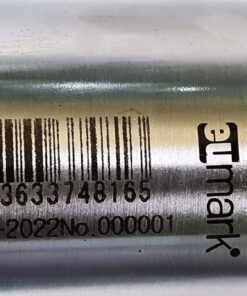
| QR codes | Generated directly in the software |
| Barcodes | Generated directly in the software |
| Image import | PNG and JPG raster files |
| Connection | Bluetooth — the printer runs without a cable at the bench |
| Print resolution | 300 dpi |
One limitation stated plainly: the software imports raster images, not vector
files. For a logo or a fixed part identifier you intend to mark repeatedly, send
us the artwork as SVG, DXF, AI or EPS and we will produce a long-life photo
stencil from it at full vector fidelity. Use the printer for the content that
changes — serials, lot codes, dates, symbols — and the photo stencil for the
content that does not. That division is how the set is designed to be used.
Stencil strategy: printed or photo-etched
The two stencil types answer different questions, and a production shop
normally uses both.
| Printed stencil (from the supplied printer) | Long-life photo stencil | |
|---|---|---|
| Lead time | minutes, in house | ordered from us |
| Service life | short run | up to 5,000 marks |
| Best for | variable data — serials, lot codes, dates, one-offs | a fixed logo or fixed part number marked repeatedly |
| Cost per stencil | a few centimetres of tape | per-stencil price, amortised over thousands of marks |
The figures line up into a simple production picture. A complete cycle —
mark, wipe, load the next part — takes around 10 seconds, so a steady working
rate is roughly six parts a minute. A 200 ml bottle of electrolyte delivers up
to 20,000 marks, which is on the order of 55 hours of continuous marking at that
rate. The 100 m tape roll covers a large number of printed stencils; at a 50 mm
stencil length, roughly two thousand. Between the two, the
consumable cost of a marked part is small enough that it rarely survives as a
line item in a costing exercise; the comparison that matters is against the
capital and maintenance cost of the alternatives.
Electrolytes — what each one is for
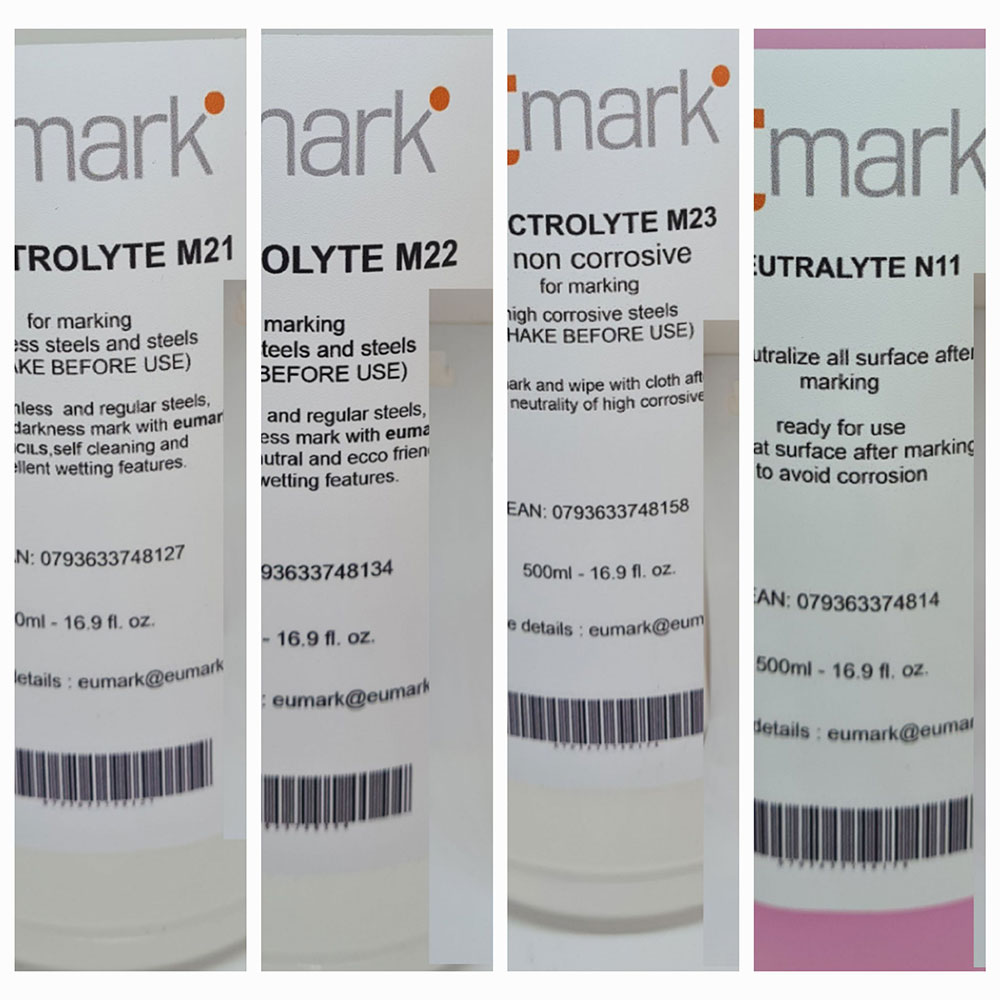
Four fluids are supplied, each in a 200 ml bottle. The differences between
them are practical rather than marketing distinctions, and they decide how the
system behaves over a shift.
| Fluid | Behaviour | Specify it when |
|---|---|---|
| M21 | Self-cleaning. Delivers a high number of marks from a single wetting of the felt. | Running a batch. The operator is not stopping to re-wet or wash between parts, which is where most of the cycle time in manual marking actually goes. |
| M22 | Produces a very dark mark and is the fluid used for deep etch. The felt has to be washed after use. | Maximum contrast is required, or the drawing calls for etch depth rather than surface contrast. |
| M23 | Non-corrosive. Formulated for marking highly corrosion-sensitive materials. After marking, the surface is simply wiped with a dry cloth. | Marking corrosion-critical components, or where a wet neutralisation step is impractical or unwanted on the part. |
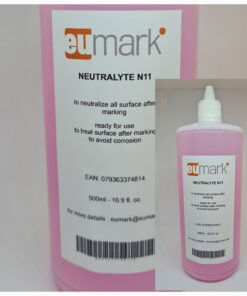
| N11 Neutralyte | Protects the marked surface after etching. | Standard finishing step following M21 or M22. |
Please read this before ordering: the table above is a
recommendation, not a specification. Alloy, condition, surface finish and prior
treatment all influence the result, so trial marking on your own material is a
required step — not an optional one. Send us a coupon and we will do the first
trial for you.
Formulation and documentation
The greatest single advantage of these fluids is not how they mark. It is
that they are formulated to the requirements applied in medical, aerospace and
food-contact production, and that a safety data sheet is supplied for
every fluid. Quality departments need those sheets for incoming
material control, COSHH-equivalent assessments and audit files — and in
regulated manufacturing, a consumable without documentation is a consumable that
does not get approved for use, whatever it does on the bench.
Safety data sheets are issued with the consignment and are available in
advance on request, so your quality function can review them before the purchase
order is raised.
Traceability and identification requirements
The system produces permanent, non-destructive marks of the type that
identification requirements call for: UDI carriers on reusable instruments under
EU MDR 2017/745, part and serial identification within an
EN ISO 13485 or EN 9100 quality system, or a
customer drawing note specifying a permanent marking method that does not alter
the base material.
To be clear about where responsibility sits: the equipment is not certified
to any of those standards, and no marking equipment is. Legibility, contrast,
depth and — where data matrix symbols are used — grade verification are
qualification activities you perform on your own parts. The system is built so
that the qualification is short, because there are only five variables to fix:
current mode, dwell time, electrolyte, felt saturation and stencil condition.
Surface integrity and passivation
Marking introduces no heat, no recast layer and no residual stress, so
hardness, temper, fatigue behaviour and finished dimensions are unaffected. On
stainless steel, neutralise the marked area with the supplied N11 immediately
after marking and passivate the part under your existing procedure. Handled that
way, a marked coupon performs the same as unmarked surface in a standard
corrosion check — which is worth confirming once, during qualification, and
recording.
Frequently asked
How does this differ from Set 03, which also includes a printer?
Set 03 supplies the P58D printer with 58 mm tape in 10 m rolls and sample
quantities of electrolyte. SUPER SET 04 supplies the wider 108 mm printer, a
100 m roll and full 200 ml bottles of all four fluids. Set 03 suits occasional
marking; Set 04 is specified when marking is part of the daily production
routine.
Can we mark a different serial number on every part?
Yes — that is the reason this configuration exists. Print the stencil,
mark, discard. There is no per-design tooling cost and no waiting.
What is the smallest character height that reproduces reliably?
Determined by the stencil and the part surface finish rather than the marking
unit. The printer resolves at 300 dpi; strokes below roughly 0.2 mm tend to
close up regardless of how they were produced. Tell us the character height, the
symbol size and the part finish you need, and we will tell you what is realistic
before you order rather than after.
Can the system produce QR codes and serial numbers for UDI marking?
Yes. Sequential serial numbers, QR codes and barcodes are generated in the
included software and printed straight to stencil tape. Symbol grading against
your applicable standard remains a verification step you perform on your own
parts — send us the symbol size and part finish and we will tell you in advance
whether it is likely to grade.
Will the mark survive steam sterilisation and alkaline cleaning?
Yes. The mark is a conversion of the metal surface, not an applied coating,
so there is nothing to lift or dissolve. This is the basis of the method’s long
service on reusable surgical instruments.
Can we get sample marks on our own material first?
Yes, and we recommend it. Send a component or a coupon in your production
alloy with the marking content you need, and we will return it marked. It is a
better basis for a first-article discussion than any specification sheet.
How does delivery within the EU and UK work?
Consignments dispatch from Serbia. Under the Stabilisation and Association
Agreement, goods of Serbian preferential origin enter the EU at zero duty on
presentation of an EUR.1 movement certificate or an invoice declaration, which
accompanies every shipment. UK consignments are handled the same way under the
UK–Serbia agreement.
Before you specify
Send us the alloy type, the component geometry, the marking content and your
annual volume. We will confirm that SUPER SET 04 is the right configuration —
or tell you if a smaller one covers it.
eumark@eumark.de
| Weight | 5 kg |
|---|---|
| Dimensions | 33.7 × 33.2 × 18 cm |
Related products


Electrochemical etching
2 psc Marking Felt – Filz for electrochemical marking etching 375x500mm 10″x19″

Electrochemical etching

Electrochemical etching


Electrochemical etching
Electro Chemical marking and Etching Machine EUmark set 06 compact with stencil printer
Electrochemical etching
Electro Chemical marking and Etching Machine EUmark set 05 compact